Personal Finance Archives - Page 18 of 20 - Financial Literacy

Archive for Personal Finance

Beware of governments with growing debts

Washington DC

  • In 2012, the Greek government sold off billions in public property for a fraction of its value.
  • In 2013, the European Central Bank stole individual bank deposits in Cyprus.
  • A couple weeks ago, the Polish government stole billions in bonds from private pensions.

The Polish government was forbidden from borrowing money after their national debt level rose above 50% of GDP (gross domestic product). Instead of living within their means, the government stole the bonds in private pension funds to get under the 50% limit and now they can borrow and spend again.

Remember that back in 2010, the Obama administration was exploring ways to force IRA and 401(k) accounts to purchase a new type of U.S. Treasury Bonds (these were nicknamed Obamabonds). This would have been an avenue for the government to borrow trillions with an artificially low interest-rate, to the financial detriment of IRA and 401(k) account holders.

When governments need money, history repeatedly tells us that they frequently find some way to steal it from its citizens. The prudent lesson is to divide your assets among several different locations and a few of them that are difficult for authorities to access.


Year-end financial planning to consider

sunset - small

Now that summer is ending it is a good time to look at your finances for year-end planning.

Retirement Accounts:

  • Make your target contributions into retirement accounts.
  • Determine if it is beneficial to convert IRAs into Roth IRAs.
  • For people older than 70 ½, make IRA and 401(k) mandatory minimum distributions to avoid penalties.


Investments:

  • Determine when lower long-term capital gain taxes apply to your investments.
  • Tax-loss harvesting: matching capital gains and losses to see if it is beneficial to sell something before year-end.
  • Rebalancing the asset mix of your portfolio.

Crystal Ball Analysis:

Is it likely that taxes will increase or decrease next year on income or transactions you expect to make next year? If this year’s tax rates are more favorable for something, then minimize your tax liability by accelerating items before year-end, otherwise delay those transactions until after year-end.

Other Items:

  • Adjust your payroll tax withholding if it appears that it is too much or too little to avoid penalties or large refunds.
  • Maximize insurance benefits, for example, if your health insurance deductible will be met then plan any appointments or procedures before year-end when they reset.
  • Deplete flexible health spending accounts before they are lost at year-end.
  • Make charitable gifts and any cash donations for the current year.

None of these items will automatically occur on their own for your benefit so make sure you complete what is needed to keep your finances on track.

What is your savings rate?

piggy bank

As a general rule, when people are afraid of losing their job they increase their savings rate and when they are confident about keeping their job they reduce their savings rate. This occurs across cultures and countries. When a country goes through a severe economic crisis, then the savings rate makes a permanent increase from psychologically-scarred survivors. For example, the Great Depression, areas destroyed in World War II, countries hit hardest with the 2007 financial meltdown, all of these places change attitudes that you must rely on your own savings.

China is a country with little social safety net and the common saying is, “If you do not work then you do not eat”. As a result, they have one of the highest savings rates in the world, 38%. Ireland has a savings rate that quadrupled after getting hammered by their government and bank losses of 2007; their savings rate has now calmed down to 7.3%. Each country has its own tax structure, safety net, and economic memories that combine for a savings rate. The savings rate in the U.S. today is 4%, down from 5.5% during the financial crisis a few years ago.

What is the lesson? Do you want to wait until after you lose your job to consider saving more money or do you want some savings in a secure location before there is a problem? The ancient money adage to save 10% is a fine starting point, but have you mapped out all of your savings needs to know if this number is adequate for you? Retirement needs? The sooner you do this the more stable your financial future will become.


Social security payments are a retirement maze you need to map out

Social Security Reform Becomes A Divisive Issue

Many people reaching their late 50’s that are tired of their career tell me they are planning on taking social security at the earliest possible age (62). The reasoning they commonly tell me is, “I want to spend the money now and who knows how long I’ll live.”

Only if they ask for advice, I tell them, “That is a colossal financial error. You have paid into this program your entire working career and now you are going to choose to settle for less than 50% of what you are entitled to each month?” Before I start listing all of the reasons why they should wait, I explain, “Social security benefits are very complicated. It is most likely that you can increase your monthly payment by 75% to 125% by mapping out the best strategy. You need to understand how to benefit from “file and suspend”, “restricted application for spousal benefits”, and many other tactics (particularly if you are married) before you make a move that permanently reduces your social security benefits.”

For most retirees, income from social security is their largest income source and greatest asset. Do not elect any benefits until you have met with an expert in social security income planning to maximize your benefits and retirement lifestyle. Remember that there are hundreds of ways to claim social security but SSA employees are legally prohibited from provided any advice.

Are your advisors a booster or anchor to your success?

meeting_jpg

When it is my recommendation to someone that they should replace an advisor with someone else (accountant, banker, lawyer, financial planner, broker, realtor, etc.), their first reaction is always, “But they are so nice and I’ve been with them for so long!”

I reply, “Every salesperson is charming and every professional is friendly. You are the CEO of your ‘family business’ and when they have continually proven that they are inappropriate for your circumstances then it is time to replace them. You are basically paying them a fortune for their friendship while they’ve driven your finances into a ditch.”

The easy test for your advisors is: are they experts for what you are doing today and what you are going to be doing in the foreseeable future? If they are not then it is time to search for a better and more appropriate replacement. Do not allow your advisors to become financial anchors dragging down your time, income, and net worth while increasing your risks. Periodically review all of your advisors and what they are doing for you to make sure they are an asset and not a liability to your financial success.

Will your estate get to people and organizations that are important to you?

When was the last time you went through your estate plan? Has anything in your life changed since then? Since I am fresh from assisting two people through this, let me comment on two frequently overlooked items.

First, your Will does not determine the recipient of your retirement accounts when you pass away. These accounts can only be assigned to the people that your retirement account administrator has in their records. Please call the company and have them mail to you who they currently have on file as your current beneficiaries are so there are no surprises. For example, you may discover that your beneficiary is an ex-spouse, a relative who has passed away, or a non-profit that no longer exists.

Second, a year does not pass without Washington making a dozen laws effecting estate planning: trusts, taxes, exemptions, caps, and a maze of other events. While you are updating your estate plan each year for changes in your circumstances and wishes, you also want to make certain that elements are not obsolete or incorrect based on current law.

Every year there is a celebrity that passes away and estate lawyers show how what they did was structured so poorly that they needlessly paid far too much in taxes, gaps were left to allow a Will to be unnecessarily contested, and some of the beneficiaries were accidentally cut out.

Do yourself and your loved ones a favor and periodically review your estate plan to keep it current and correct.

Is Your Money on Fire?

money fire

Consumer debt can creep up to large amounts even with small purchases. How you handle this debt determines whether you are financially moving ahead or falling further behind. When you have consumer debt, do you scramble to extinguish it like your hair is on fire or just ignore it? When you have consumer debt, your wallet is figuratively on fire – money you earn is already pre-spent on interest expense!

Shopping expert, Martin Lindstrom, offers 3 general tips proven to reduce your impulse purchases:

  • Keep your cash in $100 bills because it is more painful to break it than smaller denominations.
  • Go through grocery stores with only a tiny basket or even better, no basket. You’ll reduce your spending by 40%.
  • Many of your shopping decisions are made subconsciously so be more alert when there are sights, smells, and sounds to distract you (for example, a fair, grocery bakery, or casino.)

Is Your Retirement Savings on Track?

retirement assets 7-2013

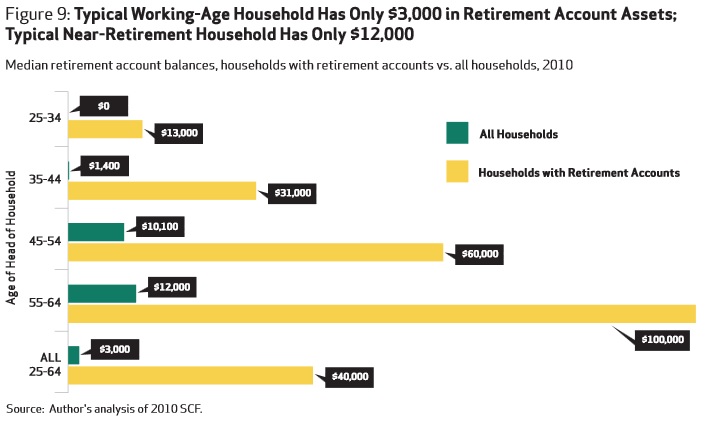
The National Institute on Retirement Security released a survey this month. Some of their results show that among workers aged 55-64:

  • One third have zero retirement savings.
  • One third have retirement savings worth less than 1 year’s salary.
  • Only 8% of them have retirement savings worth over 4 times their annual salary.


How much should retirees have in savings?

Fidelity recommends 7 times your annual salary, Aon Hewitt recommends 11 times, other brokers recommend numbers between 8-10 times your annual salary so that you can live on 85% of your working income. You can do some math to estimate how much you may need and determine whether your retirement will be closer to financial ease or financial struggle.

The City of Detroit just declared bankruptcy due to unaffordable pension obligations. Many states, cities, and companies also have underfunded pension funds. Sooner or later, either the pensions will be reduced or contributions will have to be increased (many times this is an impossible number). Are you prepared for a reduction in your pension income? Each day, 10,000 baby-boomers hit retirement age and will strain the budgets of any program they are relying for financial relief. Make certain your personal retirement is a prosperous one by doing it on your own and under your control.

6 Years after the Financial Crisis – How is the Economy Doing?

Employment 7-2013

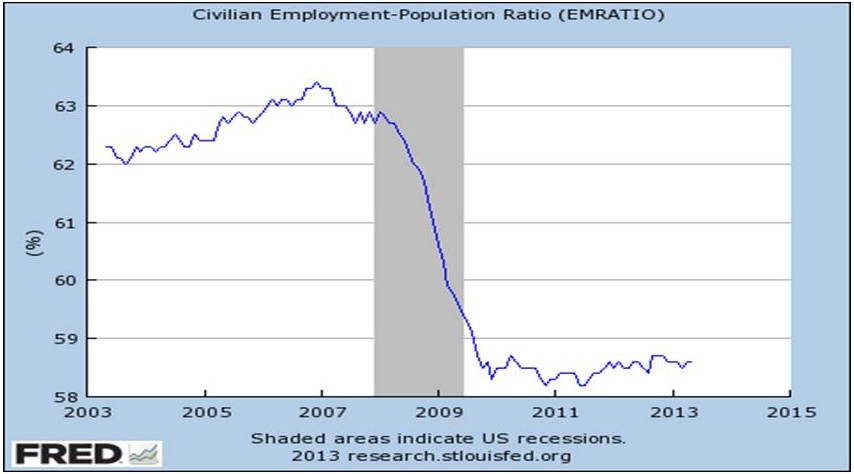
The recession that started in late 2007 has sharply knocked many people out of the workforce. Although it has been over 6 years there are still 12 million people that are under employed and waiting for their personal economic recovery. A generation is literally being lost to under employment: all of the normal markers of economic improvement are missing for 20-year olds. For example, many are still living at home, avoiding car ownership, missing out on a professional career, renting instead of owning a home, and replacing optimism with pessimism about the future.

Home ownership is a desirable element for a community. Home owners treat their living quarters better, take a more active role in shaping and stabilizing the community, etc. But home ownership has fallen from 69% to 65%, the lowest rate in 18 years.

These two elements, employment and housing, must stabilize and improve before any other economic strains are relieved: state and federal deficits, improving corporate sales, along with the U.S. Federal Reserve printing money and keeping interest-rates low.

Mortgage Interest-Rate Asymmetry

Mortgage rate increase

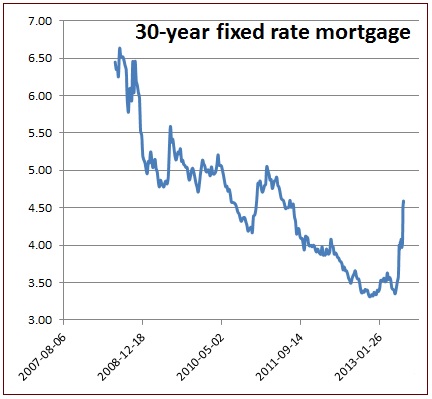
While I was growing up, my father repeatedly taught me that when mortgage interest rates are going down, they slowly creep lower. But when interest rates are rising, they leap upward. The lesson is always have a fixed interest rate for the length of time you plan on being in the home. This is because a variable interest rate can unexpectedly skip upward, well beyond what is affordable to your income, and force you out of your home. I have known people over the years whose homes were foreclosed upon when their variable mortgage interest rate ratcheted up and one issue or another prevented them from being able to re-finance.

Last year, my own bank wanted get me into an adjustable-rate mortgage. I asked, “And what do I do if interest rates move up?” He replied, “Don’t worry about it, if rates starts to move up then we’ll re-finance into a fixed rate.” Well, I’ve seen the end of that movie many times and it does not end well.

So what has happened lately? In the chart you can see that mortgage rates have risen by over 1.2% in less than 2 months. This rise is faster than mortgage rates have risen in over 50 years. As a result, more borrowers are opting for variable rates to try to save a little money. Unknowingly putting their home at risk to save a few dollars – only to lose their equity in the next round of foreclosures in a few years.

Menu Title