Personal Finance Archives - Page 16 of 20 - Financial Literacy

Archive for Personal Finance

Savings = your future lifestyle

national safe

A hundred dollars in your hand is a physical object but it represents your future spending and your potential lifestyle. Whether you spend it later today or 20 years from now, it is available for spending which increases your lifestyle. When there is no extra money then your future spending is zero and lifestyle will be falling. This is a concept that many people avoid until it is too late to save for an event, an emergency, or retirement.

The U.S. Federal Reserve Board just released the results of a poll that indicates 31% of Americans have no retirement savings at all and 52% of Americans could not come up with $400 for an emergency. Since the 2008 financial crisis, over 2 million Americans over age 55 could not find work and were forced into an “early retirement” of financial struggle.

Any savings that you set aside creates the possibility for a future with a: large purchase, vacation, education, new vehicle, or the possibility of a comfortable retirement. In order for your savings goals to be met, your money that is set aside must be earmarked, scheduled out, and defended from being spent on something else.

When you place your savings or investment money with a person or institution, you must be certain that it will be professionally managed in a conservative manner. This money will become your physical future and if it is mismanaged then so is your future lifestyle. A month does not pass by in the news without some kind of Ponzi scheme or fraud where many victims had placed much or all of their money with a smooth-talking criminal. All of the victims believed they were dealing with someone trustworthy so they did no homework on the person or the investment. The victims did not perform an audit, due diligence, review, or background check to be certain of its legitimacy. Instead, they just handed over their life savings only to have it all stolen.

Determine financial goals that are important to you and support each of them individually with savings rates and targets to make them happen. Then you will need to defend this money from unscrupulous operators and even yourself from spending it on something else when it is convenient.


How can I retire early?

kauai hawaii

In my experience, once someone is over age 50 it is a common desire to consider the possibility of an early retirement. I have gone through the math and mechanics with many people and it is rare for someone to have the financial capability retire early, in comfort, when including potential health care expenses.

Most people have little free time beyond their job, family, home maintenance, hobbies, and social events. Unfortunately, early retirement is only for those who carve out time and effort to go well beyond having an average income and setting aside 5-10% of their income in a retirement account.

Early retirement is at the end of 3 paths. You can choose any one of the three paths or combine them to make it happen even sooner. The three paths are:

  1. An extraordinarily high income.
  2. An extraordinarily high rate of savings.
  3. An extraordinarily high return on investments.

Let’s go through each of these. An extraordinarily high income would be either from a career with a high-income trajectory (3 or more times the average income) or a normal career with a side-income or business. By definition, not many people are on track for an extraordinarily high income. I won’t go over career planning in this post, but this path is usually a professional career with a lot of education or sales ability. However, what most anyone can do is start a part-time side income with some examples being tutoring, window washing, painting, or anything else that you can work around your schedule.

The second path is having an extraordinarily high rate of savings. This refers to how much money from your income do you set aside for retirement each month, is it 5%, 10%, 25%, or 50%? You can use any retirement calculator, and even when starting from zero, you can retire in 10 years if you are a hyper-saver setting aside +70% of your income. There are many websites for hyper-savers for ideas and support in reaching a very-fast retirement. Although hyper-saving isn’t appealing to most people, the math that it highlights is the same for every potential retiree; whether you are saving 3% or 30% for retirement.

The third path is an extraordinarily high investment return rate. This refers to the profitability of your retirement accounts, how hard they working for your retirement. The average mutual fund investor earns 4%, or less, over long periods of time (according to Vanguard research), and that is simply not high enough for an early retirement – based on an average income with an average rate of savings. Extraordinary returns normally come from being an active real estate investor, active stock trader, active direct business owner, or other active investing areas.

How many of these three paths to early retirement are you currently doing? Sooner or later, you may want to have the option of an early retirement when your career stalls, health issues arise, difficulty finding work, family issues, or other reasons. The sooner you actively move forward on these three paths, the sooner you’ll have more financial options in your future, including an early retirement.

Washington D.C. predicts tax increases for decades

uncle sam

Part of financial planning is predicting the likelihood of future tax increases or decreases. This estimate is needed to make any decisions with tax implications – do them now or later depending on which way tax rates are headed.

A new report just released from the U.S Congressional Budget Office (CBO) offers clear guidance for U.S. taxpayers to use. The CBO summarized by saying that over the next 25 years, people at all income levels will be paying a larger share of their income in taxes; even if there are no tax increases!

Some specifics include:

  • The mortgage-interest deduction will be cut in half
  • More people will have to pay income tax on their social security income
  • Obamacare taxes will increase and include more people than today

These increases will occur with no changes from the current rules. However, the CBO also points out that the national debt is skyrocketing from the deficits generated by: Social Security, Medicare, Medicaid, and Obamacare. The CBO claims these debts are NOT sustainable indefinitely, could possibly create a financial crisis, and so additional tax increases will be necessary in the future as well.

So for now, when you have a tax decision to make, such as triggering income or gains now vs. later, it is financially advantageous to do them now rather than a few years from now at higher tax rates.

Retirement planning alert – inflation

Meat inflation

One of the challenging financial dilemmas everyone faces is budgeting for retirement. This begins early in a career when retirement cannot be fathomed and ends when it is an imminent fact of life. For most people in their working career, retirement planning is little more than periodically adding some money to a tax-sheltered account.

As retirement approaches, we all have the face the reality of our past decisions and future financial needs. Whether you do your own financial planning or hire an expert, in my experience, the most commonly overlooked item in retirement planning is inflation.

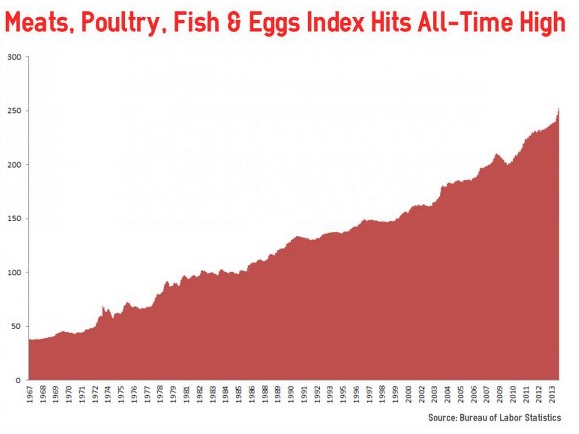
This chart from the U.S. government tracks retail protein sources: beef, poultry, fish, pork, and eggs. From 1967 to 2014, the average annual increase is 4.01%, and it has been fairly steady with any drop proceeded by a new high within a couple years. The impact of this on your budgeting is this: you need to plan for a 4% increase in the price of these items during your retirement. Since the average retirement may last 20 years, as an example, if you spent $1,000 on these proteins in the first year, these would then potentially cost you $4,400 in the 20th year. This reflects the impact of compounding inflation year after year.

This is just one food item that you’ll be budgeting for in your retirement. Yes, some expenses may decline or be eliminated, but many if not most will increase during your retirement. Budgeting is individual, and you can make a rough overall guess at an annual inflation increase; but it is best to examine each of your own expenses. If you don’t want to do that detailed work at least look at your 5 largest expenses to determine if they will likely be going up or down and a rough estimate of how they may change in your future. For example, where I live, property taxes just went up 11% this year and the city just approved an 8% increase in water rates. These increases don’t happen every year, but an increase of some type for these local expenses over any 5-year period is nearly guaranteed.

The important point to consider is to include several inflation rates and spending scenarios in your retirement planning. This will prevent or minimize foreseeable financial problems when you are retired and least able to maneuver for more income.

Financial calculators – a necessary planning tool

calculator

Country Financial, a financial planning service company released some results of their latest survey on middle-income families. They found that 50% of workers earning under $30,000 are saving nothing for retirement; 20% of those earning $30,000 – 50,000 save nothing; and 10% of those earning up to $100,000 save nothing. Among those middle-income workers that have a 401(k), almost one-third have no idea what investments their money is going in to.

Surveys like these highlight the need for financial awareness and financial literacy so that these workers and families will avoid predictable financial difficulties. One very useful tool for mapping out your financial life is the use of financial calculators. There are hundreds of them across the web that you can use. However, like everything, some are better than others. You need to understand which most closely matches your circumstances and which has assumptions that you can change to match your situation. Luckily, financial expert Todd Tresidder has narrowed down the calculator world into a helpful list on his website page here: http://financialmentor.com/calculator.

Tresidder has calculators for retirement, mortgages, credit card payoff, car loans, investing, savings, budgeting, and a couple dozen others that you may find very helpful. What does it tell you when experts spend a lot of time with financial calculators? That they are useful, if not critical, to mapping out your financial life and your financial future. How do you know where you stand if you do not plot out what you are currently doing so that you can make appropriate adjustments now, when it matters? Please bookmark that page, go through the list to find which ones may be helpful for you today.

How safe is your pension?

pension guaranty

Even though the stock market is at an all-time high and bonds are at a 30-year high, many pension plans are dramatically underfunded. So, what do you predict will happen to these pension plans if stocks and bonds inevitably experience a decline? That’s right, dangerously low shortfalls.

The average pension fund has only 77% of the assets they need to meet their legal liabilities. When pension plans become insolvent, they are taken over by the federal Pension Benefit Guaranty Corporation (PBGC), similar to FDIC insurance for bank accounts. Unfortunately, the PBGC is already running deficits and, by its own estimate, there is a 91% chance they’ll be insolvent by 2032.

The city of Detroit is cutting the pension benefits of city employees by 26% as part of its recent bankruptcy. There are public pension plans already reducing future cost-of-living adjustments that are necessary for pension recipients to keep up with inflation. These pension cuts can occur to anyone relying on a pension plan that is underfunded or in peril of becoming insolvent. The state of Alabama is predicting their pension fund will go broke and New Jersey just cut $2.5 billion to its pension payment to fill in the state budget deficit.

On a related topic, U.S. interest rates are still near record lows and yet, government deficits are still unusually high. If interest rates on government debts return back up to normal levels, then deficits will be markedly higher. This will also put pressure on reducing pension benefits for government employees; let alone social security.

In every financial area of your life there is one important lesson: you are on your own. You need to act as if you’ll get half your pension, half your social security, etc., and create your own retirement plan that is under your control. Anything money-related that you leave for others to manage creates an additional risk of not meeting your financial needs.

Trend in spending above your means – Version 3.0

junk jewelry

There are two primary ways that anyone can use to live above their means, meaning they are spending more money than their income can sustain without creating a financial crisis. The first way, the invisible way, is to spend the money that should be set aside in savings to maintain and replace physical items. When you cannot afford to maintain or replace the items you use then disrepair will inevitably result in a drop in your lifestyle from where it is today. The second way to spend beyond your means is to access and spend credit. There are many ways to access credit, such as a pawnshop, payday loan, or car loan. However, for the average person to consistently spend above their means and imperil their finances, there have been 3 giant trends. Each of these trends leaves the borrower poorer with interest charges, tax penalties, and a weaker financial foundation.

Version 1.0 – Credit Cards 

Although credit has been around for thousands of years, the ease of access to credit for Americans didn’t expand until Visa and Mastercard were formed in the late 1960’s. Prior to that, you pretty much had to pay cash for everything but a home or possibly a car.

Version 2.0 – Home Equity

Anytime that real estate prices take off, such as the late 1970’s or early 2000’s, homeowners extract their equity to spend by taking out home equity loans or second mortgages. One mortgage broker joked to me in 2007, “I have a lot of clients who refinance twice a year to extract more money. But there is one client who is always borrowed to the maximum but would still borrow an additional $20 every time his home would go up in value, if I’d let him.

Version 3.0 – Raiding Retirement Accounts

According to the IRS, $60 billion was withdrawn early from retirement accounts in the last 12 months. Be aware that these early withdrawals triggered tax penalties of 10% of the amount taken out. Raiding retirement accounts early began with the Great Recession of 2008 but since then it has only increased over the last 7 years. Families that were struggling financially looked around for spending money and saw no savings, no home equity, and no credit, so they targeted the one asset they had left, retirement accounts. Unfortunately, U.S. underemployment hasn’t improved since 2008 so the average American continues to struggle financially. Perhaps this is why Fidelity Investments just reported that the average 401(k) balance for someone over age 55 is only $65,300 – a woefully inadequate amount to support any kind of comfortable retirement.

Each of these living-above-your-means versions are for the financially illiterate who haven’t mapped out their financial life and create bigger problems than they solve.

Income shifting is not just for global corporations

tax flowchart

Apple Inc. has $170 billion in cash on their balance sheet, and yet, they are going to issue $17 billion in bonds. Whatever for? To circumvent the double taxation that U.S. corporations have to pay on all overseas profits. Corporations keep their overseas profits out of the U.S. so they aren’t taxed twice, at up to 35%. As a result, the cash that Apple wants to buy back its own shares to reward shareholders has to come from issuing bonds in a foreign country.

Similarly, there is tax arbitrage between U.S. states. Maryland and New Jersey imposed a ‘millionaire’s tax’ on high income earners to balance their budgets. But those high income earners simply moved to a nearby state. Both Maryland and New Jersey saw their tax revenue plummet from high earners when they expected a sharp increase from the new tax. Many wealthy with a few residences simply spent more time at one of their other homes in a state with less income tax.

Small business and part-time business owners open limited-liability companies in states with no income tax. If your business is performed online or a holding company, it does not have to be in the state where operations are performed. Having worked in venture capital, tax liabilities of all kinds are very important to investors and forming a start-up legal structure in states or locales with low tax rates is often mandatory.

Retirees on a fixed income are more sensitive to taxes of all kinds and can enjoy a higher standard of living by relocating to a state with a lower overall tax burden. Many people only focus on income taxes but you must compute sales tax, property tax, and other taxes to your particular situation.

As taxes continue to increase, getting expert advice from someone who specializes in tax planning (not just a tax preparer,) is critical to minimize your tax burden. Plus, they will know what all you need to do to comply with tax rules so your effort isn’t undone by any tax-compliance audit.

Rising commodity prices and strained budgets

sugar bags

Around the globe, commodity prices are rising for the last two months: beef, chicken, milk, wheat, corn, and pork. Sugar is up 20% in the last two months and coffee is up 70% over the last 3 months. Drought conditions in California, the Middle East, along with unrest in Ukraine are pushing many prices upward.

Part of financial literacy is consistently ratcheting up your income for inevitable rising costs. Every season there are price rises of some type that are straining budgets for people on fixed incomes. Which is the secret to keeping ahead of these price rises – never have a fixed income. Each year you have 12 months to either actively more income or add to your investments that produce passive income such as interest, dividends, and rental income.

To be more aggressive, you can create your own hedge reserve from exchange traded funds (that trade like stocks) for a dozen commodities – gasoline, gold, corn, cotton, heating oil, coffee, natural gas, sugar, etc. If any of specific commodity makes up an important part of your budget, you make want to consider a hedging strategy mentioned the in post on 5/13/13 on “Timing Your Gas Tank.”


A great way to prevent identity theft

padlock

Nearly every month there is some sort of data breach of personal information by some company or government agency. The NSA, FBI, and even new Consumer Financial Protection Bureau perform personal data mining without warrants on your transactions or e-mails. The Obamacare website, in development for three years, was released without any security protection for personal information and several breaches were reported within the first month.

To combat companies and government agencies losing your information from theft or accident, some people enroll in a credit-monitoring service to find any suspicious activity from fraud or identity theft. But this is too late! The damage is already done, money may have already been borrowed and spent in your name.

The best way to prevent identity theft is stop it before it occurs by locking or freezing your credit report. When you lock your credit report, no company can access it without your prior approval. So if an identity thief want to open a credit card in your name, he or she will be prevented from doing so because the credit card company will not have access to your credit report.

Locking or freezing a credit report is a flexible feature, you can unlock it for a particular creditor that you want to have access. Or, you can totally unlock it and re-lock it to fit your circumstances.

To lock your credit report, you must contact each of the three credit reporting agencies, TransUnion, Equifax, and Experian. Today, they charge $10 to perform this and two of them allow you to lock your credit report online, Esperian requires a written letter.

Menu Title