Personal Finance Archives - Page 9 of 20 - Financial Literacy

Archive for Personal Finance

Strive to avoid financial ‘averages’

Do you want average school grades, average restaurant food, average pay, or average anything at all? Of course not. When it comes to your financial life, this is far more important to avoid because the average person is horrific at money management, investing, or anything else money related.

The average person has many failures when it comes to money:

  • Never learns how to manage money while growing up
  • Never saves money before their 30s
  • Takes out far too much in student loans for college
  • Has credit card debt he or she cannot pay off
  • Buys a car with an expensive loan, or worse, a lease
  • Spends far too much on housing, vacations, and bars/restaurants
  • Does not save nearly enough for retirement

If the average person is a financial calamity, then you may want to know their average behavior so that you can stay far ahead of them. For example, when the average household has less than $1,000 in savings for emergencies, you do not want to be average. When the average household has a net worth at a certain low level by a certain age, then you want your net worth to be far, far beyond that level.

I just learned two more average statistics today:

  1. The average Millennial spends more on coffee per week ($10) than they put toward retirement.
  2. The average college graduate defaults on (or doesn’t pay down) their student loans within 7 years.

It is common that you’ll come across many news headlines about average-money statistics. Keep in mind that if you are behaving like them, then you too are heading toward needless financial troubles. Please don’t be average.


Markers leading to a life of poverty

In 2013, the Brookings Institute performed an analysis on which influences lead people into poverty or the middle class. The U.S. government spends a trillion dollars a year to help people living in poverty. From the zillions of theories on paths leading to being poor or middle class, they were able to determine 3 factors that made the largest difference, by far.

If these 3 factors are present, anyone has a 75% likelihood of moving into the middle class, nearly a guarantee. However, if you violate all three of these items, your likelihood of falling into poverty is 76%, also nearly a guarantee.

These are the 3 rules they discovered:

  1. Graduate from high school.
  2. Have a full-time job.
  3. Do NOT have children out-of-wedlock or get married before age 21.

So if you want to follow the path of poverty: drop out of high school, have kids with no spouse, and avoid full-time employment. The Brookings Institute found that these 3 rules applied to all ethnic groups and backgrounds. When a culture allows these 3 rules to be routinely violated, then that culture becomes impoverished. As an example, the report mentions that 70% of inner-city black children and 50% of Hispanic children are born outside of marriage. In general, single-parent households are less stable and less likely to provide the educational and financial support needed to graduate high school and launch a successful career. As a result, children growing up in single-parent households are 4 times as likely to become another generation living in poverty. Note: even if the children grow up in a family where parents are serially married, their financial outcome is far better than children living in a household with both parents who are committed to each other but unmarried.

Meanwhile, those in the upper-middle class do these:

  1. Graduate from college and may attain advanced degrees
  2. Have full-time high-paying professional careers.
  3. Get married after age 25 and have children only after they are married

So do what you can to keep your family and friends on track.

Do you know precisely where your money is spent?

Author and blogger, Thomas Corley, wrote a book after interviewing hundreds of self-made millionaires. He recently wrote on his blog, “Do you know where your money goes? Some people do. They are called self-made millionaires.”

Of course, ‘knowing where your money goes’ is only one of the puzzle pieces for becoming a millionaire. However, it is an important foundational skill for both personal and business financial management. In order to have savings for investing and learning, there must be surplus money at the end of each month, quarter, and year. For that to happen, you need financial awareness to know where your money is going in both your personal life and business life. It is the only way to reveal reality; plus uncover over-spending and errors. And most importantly, it is a tool for setting priorities against limited resources, namely your income and time.

As an exercise in learning where your money is going, Mr. Corley recommends, “tracking every penny you spend for 30 days and then review it at the end.” I would go a step further and advise that you budget the entire year, by major categories, and then evaluate each month to determine if you are on track or not. This way, you can make adjustments before there is any financial crisis that is developing over time.

If you are interested in more of Thomas Corley’s material, this is his website: http://richhabits.net/


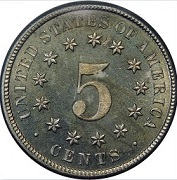
When did 5 cents turn into $5?

Venezuela’s largest denomination of currency, the bolivar, is now worth only 2-cents in U.S. dollars. The socialist government has printed money to cover its deficits, which has hyper-inflated its currency down to almost nothing.

So how is the U.S. dollar doing? It has depreciated as well, and although it is over a much longer period of time, the U.S. dollar is down about the same as the Venezuelan bolivar, down by 98%.

The U.S. currency was taken over by the latest U.S. Federal Reserve, which was founded in 1913. Since then, the U.S. dollar has lost (depending on whose inflation numbers you utilize) either 95.8% or 98.8% of its value. For example, if an item had cost $100 back in 1913, then today that same item would cost $2,442. That item has not become more valuable, the escalation in price is solely because the U.S. dollar has collapsed in value.

Back in 1879, Frank Woolworth opened a “5 Cent Store.” That later became a “5 and Dime Store” retail concept that competitors also used for decades. Can you imagine buying anything at a store for 1-5 or 1-10 cents? Today we have a modern version of that industry called Dollar Stores, and when that is not enough money to buy something of value, there is another store named, “Five Below” that sells items up to $5. So the 5-cent store has turned into a $5 dollar store, reflecting the fall of the U.S. dollar: nearly 100 fold. This is the effect of long-term inflation.

How does this apply to your finances? It is most graphic to people during retirement, a several decade period where your income is modest, mostly fixed, while inflation eats away at the currency, year after year. A decent retirement income when you first retire may not be so luxurious after a decade or two of currency depreciation. A few ways to mitigate inflation eroding your investments include:

  1. Pay attention to your investments to be sure that they earn a return that covers the rate of inflation.
  2. Put some of your portfolio into inflation-protected or inflation-indexed securities.
  3. Invest in real estate where rental income can keep pace with inflation.
  4. Invest in stocks with high profit margins and the ability to raise prices with inflation.

Financial advice just became more expensive

meeting

The U.S. Dept. of Labor passed a new regulation requiring financial advisors to always act in the best financial interest of their clients. This regulation went into effect 7 months ago, called the “Fiduciary Rule,” it is 1,000-pages long and is supposed to improve the quality of investment advice. Although this sounds like a great idea, Fidelity Investments surveyed 485 advisors about how they are responding to this rule:

  • 75% Say their cost of compliance will go up
  • 62% Will fire their small clients
  • 73% Expect it to have a negative impact on their business
  • 58% Expect their income to go down

Many smaller advisor firms are expected to close and the remaining larger firms will service only wealthier clients who can afford the new higher fees.

So the unintended consequence of this regulation is: an increasing number of people will be left with no financial advisor that they can afford. For example, State Farm is laying off 12,000 agents and will only offer a reduced number of products through a self-directed call center. Rules now require insurance products to be labeled equity products that may confuse consumers as well.

The regulation increases transparency as advisors disclose all of the ways they are compensated by different products, but you may have to actually ask for this information to get it. Fee-only financial advisors believe this regulation tilts the industry more in their favor. Opponents call the regulation, “Obamacare for your 401(k): complex rules that limit your choices and raise your costs.” Many are hoping that President-Elect Trump will cancel the regulation once he takes office.

However it shakes out, companies are spending a fortune for ongoing compliance with this regulation and somebody has to pay for that, who do you think it will be?

Critical budgeting basics for households

calculator

Many people have no interest in money management, let alone budgeting. I recently had a conversation with someone in his late 40s who still cannot force himself to budget, so his family suffers predictable and painful financial struggles.

Whatever your average monthly income may be, divide that number by weeks or days to put it into some manageable perspective.

First, determine how much of your income is available each month after you pay necessary fixed costs like rent and utilities. This leftover amount is what you can spend on variable expenses, such as food, clothing, maintenance, and repairs.

Second, select a percentage of money for savings. You’ll need to be setting aside 15% of your income for retirement, but you’ll also need a savings percentage for other savings goals: vehicle replacement, home repairs, vacations, college, and an emergency fund. Spend time to be thorough with your savings goals. This is because savings is the area that most people overlook and then start a downward spiral by putting these expenses on credit cards with high interest charges. By going over your savings goals, most people begin to recognize how far above their means that they’ve been living. Your housing and utility costs need to be low enough that you can afford to meet your savings goals.

Third, accumulate the amount of your monthly income as the “base amount” that you maintain in your checking account. This way, you can pay any normal bill whenever it arrives, avoid the stress of timing bills, and never have to face a shortage in your checking account or experience late fees. If you place bills on auto-pay then you can eliminate having to think about them; which can also reduce the burden of managing money.

A co-worker of mine grew up in a household that did not budget. Even though his father earned enough money, it was quickly frittered away. The last days of each week, his family went without food until payday, when they’d gorge themselves at dinner. My co-worker, as a successful middle-aged adult, still has emotional scars and odd food behavior from that early and repeated trauma. Do yourself and family a big favor by going through budgeting basics. Every bank offers assistance, software, and help, and libraries are filled with free books on the subject. Or, you could read my book, Financial Literacy, which outlines the steps.

How the presidential election may affect your finances

presidential-seal

If the last 100 years is any guide, the election won’t have any immediate effect at all. There are cycles to interest rates, stock market ups and downs, recessions, and for the most part – the White House occupant is not the dominant driver in any of those. But is there anything we can predict for certain?

Who knows what he or she will actually accomplish once they are in office, but there are a few big policies they have consistently said they would work toward enacting.

Donald Trump:

  1. Repeal and replace Obamacare. This will likely lower the costs of medicine but also reduce the revenues of those services or products were mandated by Obamacare. If out-of-pocket medical costs are reduced for consumers, this may increase consumer spending to boost the economy.
  2. Enact a 45% tax tariff on Chinese imports. Since the U.S. purchases a tremendous amount of goods from China, this would increase prices for American consumers in the short-term and the long-term, as China would likely respond with their own economic retaliation.
  3. Cut the budgets of the Environmental Protection Agency and the Dept. of Education. If extraneous regulations are reduced, this provides economic benefits across the country.
  4. One potential stock candidate to buy: HCA Holdings that will benefit if Trump allows U.S. Veterans to go to any doctor to get medical treatment.

Hillary Clinton:

  1. Pass the Trans-Pacific Partnership trade deal. This is a special-interest smorgasbord of monopolies and relinquishing sovereignty to corporations. I’d expect these newly minted monopolies to severely reduce economic growth for the many, to benefit a few companies.
  2. Cut red tape and taxes on small businesses. Small businesses have not been hiring under President Obama for these very reasons, this could create a large increase in needed jobs.
  3. Expand Social Security and Medicare to cover more people and increase benefits for some. Since both programs are already heading toward insolvency, this will accelerate the national debt and problems for these programs.
  4. One potential stock candidate to buy: gun manufacturers of either Smith & Wessen or Sturm, Ruger & Co. Anytime a president pushes for gun control laws there is a surge in gun and ammo sales. Firearms manufacturers say President Obama has been the greatest salesman they’ve ever had (when he pushes for gun control), and a Hillary Clinton presidency will likely be similar.

Unless you perform an industry and company-specific comparison for their specific political policies, for most people any election shouldn’t influence your investing strategy that you are holding for the long term. For example, tax policy will be modified by Congress and the Senate and so the final result may not resemble anything that the presidential candidate was trying to accomplish. After every election, political compromises and realities dramatically temper campaign promises, so predicting anything specific, in my opinion, is probably not worth your time until it actually occurs.

How secure is your money? Considering cash, bitcoin, and gold?

bitcoin-venezuela

Any location for money has risk. Even cash under your mattress is at risk for theft, flood, fire, or devaluation. Any location outside of your control adds additional risks and costs. Bank accounts are more risky these days with: bank bail-ins, IRS seizures without a warrant, and an inadequately funded FDIC insurance.

When there is high inflation, money melts in value like ice on a hot summer day. So you spend it or transfer it as quickly as possible to maintain your purchasing power. The higher inflation goes, the more worthless the currency becomes and the average person becomes more motivated to exchange it into an alternative currency. Once the inflation rate goes above 25%, exchanging your currency becomes a part-time job for everyone.

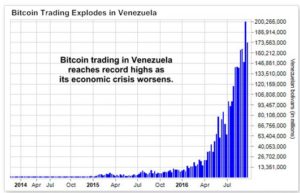
In countries experiencing high inflation, residents exchange their weak currency for the largest nearby stable currency; the Euro, the U.S. dollar, the Chinese Yuan, etc. When Zimbabwe’s currency imploded a few years ago, many store owners only accepted gold for payment. Venezuela’s currency has collapsed and as the chart indicates, an unusual currency is skyrocketing in use: Bitcoin. The more the government tries to control an economy, the greater the side-effects become, such as a worthless currency. Residents are forced into black markets and alternative currencies to store their money.

Several large hedge funds and billionaire investors are buying more gold as they expect paper currencies to fall in value; all of the major currencies together – with no safe haven. The latest is Lord Jacob Rothschild, who is also the Chairman of CIT Capital Partners. In his recent letter to shareholders, Rothschild stated that they are reducing their position in U.S. dollars for gold and other currencies.

Some of the smart money is diversifying away from the U.S. dollar. Although the U.S. hasn’t experienced moderate inflation since the early 1980s, it is common for a mismanaged economy to experience high inflation. The U.S. Federal Reserve has certainly been reckless with the U.S. dollar over the last 8 years, printing trillions in extra currency. Do you have any plan to protect your U.S. dollars from deflation or inflation?

Financial nightmares from dream homes

chambord

Anything you can buy that is unaffordable is likely to become a metaphorical financial land mine that blows up your finances. For men, unaffordable spending is commonly cars, boats, and big TVs; for women, this is commonly shoes, clothing, and vacations. But, in my opinion, there is one spending weakness that tops them all – and this is the grand purchase of an unaffordable dream home. Dream-home syndrome is when you ignore financial reality and get yourself into an unaffordable, or barely affordable, dream home that ends up becoming a nightmare.

While dream-home syndrome may strike anyone, I see it most commonly in people in the real-estate professions that are in continual contact with higher-end homes. The more you visit spectacular homes, the more you become convinced that you should have one too. However it comes about, once the words “dream home” enter your vocabulary – watch out. This loaded term permits people to ignore and override affordability because, after all, this is a dream home and therefore no expense should be spared.

If you can easily afford your dream home, this is no problem. But when it comes to real estate, the sky is the limit for the price of the lot and the remodel, which can blow through even the highest budget. Some people want the prestigious zip code, street name, water view, while others just want the spectacular home itself. Dream home syndrome even applies to a small starter home – if you simply cannot afford it and your salary is not leaping upward.

A few nightmare scenarios that I am acquainted:

  • Someone bought their dream home in the upscale part of town and then remodeled most of it. Even though they had no drop in income, they lost the home to foreclosure within four years. A lifetime of savings from frugality went up in smoke.
  • Someone made around $1 million in capital gains by selling their home near New York City. They didn’t plan on it, but ended up spending twice that amount to purchase and remodel their dream home. Only after it was too late, did they realize that the cost to finish the project will push their retirement date back at least 5 more years.
  • A couple, each earning over $250,000, built their huge customized dream home at a cost that was far more than what they could afford. But, before they could move in, they were transferred across the country and had to sell it. There were so many quirky elements to the home (a see-through floor in a hallway?) that they had to take a large loss to sell it. So this couple is in their early 60s with no retirement savings, no money, and are paying for a monstrous debt on a home they never lived in. They have already conceded that they can never retire. And yes, these are financial professionals!

I have many, many more examples, but you get the point. What are some symptoms of dream-home syndrome?

  • House hunting when you don’t have the money or a planned-out budget
  • Continuing to house hunt even though you just bought a home
  • Wanting to mimic a friend’s spectacular new home or fabulous remodel
  • Continue making additions to the list of features for your dream home
  • Failing to consider all of the costs to maintain your dream home

Let me end with a counter example. A friend of mine lives in Nevada. In the real estate boom before 2007, several of his friends and neighbors moved to bigger homes with much larger mortgages. His wife pleaded for them to get a bigger home as well but he refused to upgrade and wouldn’t budge. Five years later, those friends were losing those larger homes to foreclosure, going through bankruptcy, and sometimes divorce. In the meantime, my prudent friend paid off his mortgage and considered buying one of those upscale homes at half the price that his friends bought at the real estate price peak. Everything you purchase must be affordable or, sooner or later, it will be taken from you. The term “Dream Home” should fire off red alarms that your financial life may be in peril if you move forward without a thoughtful and sustainable budget.

How serious is your savings rate?

50-percent

I know a retired school teacher whose annual salary never exceeded $60,000. Yet, when he retired early in his late 50s, he had a portfolio worth nearly $2 million by employing a simple strategy. Both he and his wife worked and they saved 50% of their income. This 50% savings rate was one part of their strategy, the other part was investing the money in conservative stock and bond funds; nothing fancy.

When I first began working out of college, a colleague and her husband also saved 50% of their income. This aided them in buying a home in a short amount of time and prepared themselves for living on only one salary for a while when they expect to have young children. I later learned that another couple I know had the same 50% savings plan as soon as they got jobs out of college. By saving at such a high rate, 18 years later they were able to buy a second home, a lake house with all of the aquatic toys.

I am acquainted with a real estate investor that saved 50% of his day-job income for many years for down payments on single-family homes. Once he had a large portfolio of homes making him income every month, he ratcheted up his purchases to small apartment buildings. In middle-age, he quit his job to manage his growing real estate empire and he now lives in a spectacular home and enjoys a very high standard of living from all of his rental income. But he never reduced his savings rate; he actually increased it and now lives very well but only spends 17% of his income.

  • Can you save 50% of your income? Of course you can.
  • Will you do it? That is a personal choice that is up to you.
  • How about starting with a 25% savings rate to pile up a little money?
  • Or, you could join the average American and only save 5.7% of your income, and live in continual financial stress and struggle.
Menu Title