Personal Finance Archives - Page 10 of 20 - Financial Literacy

Archive for Personal Finance

Economies move in cycles, not straight lines

recession

Are you prepared for the next economic recession? Can you remember what a recession is?

Looking back a few thousand years, economies and industries move in cycles, seasons, waves – never in a straight line. Psychologists have a term to describe the failure of people to imagine or prepare for a scenario that they haven’t recently experienced: normalcy bias. This is a dangerous trait to apply to your finances because everything economic moves in waves: interest rates, currency rates, commodity prices, unemployment, and the overall economy. The most successful people are those that anticipate, prepare, and are ready to act in advance of economic moves that others do not expect.

When there is a recession, short-term interest rates go up, unemployment goes up, and people spend less because they are unsure of their jobs. These ripple throughout the economy: raises are smaller or non-existent, overtime disappears, layoffs are common, and repossessions by lenders increase because people cannot make payments. Your personal finances must include the possibility of a recession. If you’re living paycheck-to-paycheck when one hits, your lifestyle may be imperiled with a single hiccup in your income.

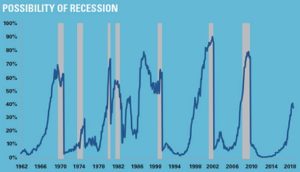
The average time between recessions in the U.S. is 6 years. However, since the 2008 financial crises, the economy has been growing so slowly that the economy never over-heated (which can turn into a recession). This slowest-ever expansion is now the longest on record. When will the next recession arrive? There are a few recession predictors: federal government tax receipts fall, short-term interest rates rise, new home sales shrinking, falling real estate values, train and shipping cargo shrinking, loan default rate increasing, business inventories increasing, and many more.

What are these recession predictors indicating today? Many of them are pointing to recession. By being aware of economic cycles of expansion and contraction, demographic changes, and anticipating these changes, you can be prepared for these changes instead of getting hit in the chin when they materialize.

Creeping lifestyle inflation

Sundancer

For financial stability, it doesn’t matter how much you earn, what matters is how much you keep and how hard that money works for you. Money cannot work for you if you spend it all each month. This describes the financial struggle of living paycheck-to-paycheck, meaning there is little or no savings.

Who is living paycheck-to-paycheck?

According to a study by Nielsen Global Consumer Insights:

  • 50% of those earning under $50,000
  • 33% of those earning between $50,000 and $100,000
  • 25% of those earning over $150,000
  • Overall, 22% of Americans have no spare cash

Those are very high numbers of people without any savings. While the paycheck-to-paycheck rate improves as income increases, it appears that far too many people are on financially thin ice.

How is it that a quarter of all people earning over $150,000 have little to no savings? Each increase in salary is consumed. This can be many things – cars, vacations, larger home, more toys, a second home, etc. So instead of becoming more financially stable as their income increases, these people become more financially precarious. They are raising their lifestyle spending and recurring expenses as fast as their income rises. When you have no savings, where does the money come from for required maintenance, repairs, and replacement of each and every item that you own? It either falls into disrepair, you borrow money and become poorer, or in the worst case, the bank takes them away from you.

Is your savings rate improving as your income increases, or instead, are you ratcheting up your lifestyle spending just as fast?

Is your retirement saving on track?

Account balance

As you are saving and investing money, a frequent concern people have is “Am I on track for retirement?” The more reference points you have about growing your investments, the more feedback you have regarding whether you’re saving enough for retirement. Better to learn now when you can do something about it before it is too late and retirement is imminent.

There are many studies regarding investable assets and net worth by age, the numbers below are from the Transamerica Center for Retirement Studies.

In your 20s, the average retirement savings is $16,000. It is likely that there are some financial struggles during your 20s: your income is relatively low and entertainment expenses are relatively high, and student loans are prevalent. However, now is the time to build the regular habit of making additions to your retirement savings every single time you earn money.

In your 30s, the average retirement savings is $45,000, but your savings balance should be 1 times your gross annual salary.

In your 40s, the average retirement savings is $63,000, but your savings balance should be 3 times your gross annual salary.

In your 50s, the average retirement savings is $117,000, but your savings balance should be 4.5 times your gross annual salary.

By age 60, the average retirement savings is $172,000, but your savings balance should be 6 times your annual gross salary.

Even if your retirement savings is not making these thresholds, it is important to keep them in mind so that you are continually make new additions to your accounts.

Difficult financial times ahead for Baby Boomers

50s savings

Historically, the percentage of people retiring with no retirement savings has averaged 25%. For the Baby Boomer generation, which is now retiring at a rate of 10,000 per day, the rate is far higher. 42% of Baby Boomers have zero saved for retirement. This will be a struggle for the country because it is going to force large numbers of them below the poverty line if they are unable to work.

On top of their poor savings rate, Social Security is scheduled to run out of money in 2029, just 13 years from today, which may lead to a 29% reduction in benefit payments to retirees. Two popular ideas to restructure social security that slightly delay their insolvency include: reducing payments to high earners and slightly raising social security taxes. But neither of these will provide nearly enough money to make the program solvent.

Since the foundation of social security retirement in 1935, it has never been more important to save your own money for retirement. Pension benefits are being cut or scrapped and social security payments may have to be cut in a decade. So that leaves your own saving and investing as your primary financial plan to support yourself in your golden years.

Do you buy items for value or low prices?

discount card

There are many purchases where the seemingly cheapest way to purchase an item turns out to cost more out-of-pocket in the end. This was highlighted recently when I took a young family friend out to lunch. A few financial topics came up and in each instance she was either surprised or disappointed to learn that she was spending more than she needed to, while thinking that she was saving money.

Let’s review some of her discoveries:

  1. She goes out to restaurants, paying full price while I had saved 20% on our meal with a discount card I bought at Costco. If I hadn’t had that discount, I would have used a coupon that I had received from a loyalty program. I also buy coupons on eBay if they are cheap enough.
  2. Another strategy is to use ‘focused purchases.’ Airlines, hotels, pharmacies, grocery stores, and restaurants reward frequent customers if you sign up for their loyalty program. So whichever brand you select as meeting your needs best, try to use their loyalty program exclusively to build up the most discounts, reward points, miles, coupons, or other financial benefits.
  3. While she had just returned from attending yet another concert in a neighboring state, she didn’t have enough money to pay her annual car insurance bill in full, so she pays more to break it down into monthly payments.
  4. Since she does not take good care of her car, she spends more in repairs than she needs to. To avoid these extra repairs, she is considering leasing a car because “she heard that it is cheapest.” So I explained that leasing a car cost 40% more than paying cash for a new car; it is the most expensive way to buy use of a car. She had also heard, incorrectly, that she didn’t have to put any money down and could still get a low lease payment.
  5. One eye opener for her was the concept of value, meaning price per use over time. For example, a cheap t-shirt that falls apart quickly and needs to be replaced is more expensive over time than a higher-priced t-shirt that lasts much longer. Cost per usage or cost for time can be applied to many semi-durable and durable purchases. By choosing a more expensive item that offers more value, it ends up being less expensive overall.
  6. She also never built a credit rating, and ‘no credit rating’ is equivalent to a ‘bad credit rating’ to potential lenders. So she was put into the expensive high-risk insurance pool and was unable to rent an apartment that she wanted.

I am not picking on her, at only 22 years old, she simply hasn’t been exposed to financial concepts or thinking about money except that it is something you can spend immediately.

I meet people far older than her that still haven’t been exposed to financial rules that lead to financial stability. For example, I had some repair work done on my house and I overheard a few conversations between the two workmen. At one point one tells the other, “Anytime I’m ahead of rent by $100 I buy another tattoo. To keep my girlfriend from getting angry about spending money that way, I buy one for her, too.” From a few other comments he made, it appears that this 34-year-old man’s financial life is in imminent crisis. He prompted his friend, “We should get tattoos this weekend!” The other man replied, “I’ve got higher financial priorities than tattoos.” But he wouldn’t relent so easy, “You don’t buy it all at once! Just pay for parts of the tattoo over time; that is how you make it affordable.” While this is true, he is still spending all of the money, whether in parts or all together; money that he cannot put toward savings or investing to turn around his perilous financial condition.

Although this man’s primary financial weakness happens to be tattoos, I have seen all kinds of unaffordable financial weaknesses: fishing equipment, shoes, concerts, jewelry, racing-car parts, wine, buying rounds of drinks at the bar, foreign travel, and even self-help seminars. If you repeatedly make purchases on a credit card that you cannot pay off in-full when the bill is due, then you may have a financial weakness to address.

Several of the wealthiest people that I know find all kinds of ways to save money on routine and expensive purchases. Paying for value instead of looking only at price is one way that they do it. Another way is to spend time learning how to save money on large expenses. For example, a relative drove a brand new Jaguar sedan for 3 years and ended up making a $7,000 profit when he sold it, based on expert use of tax law. Another relative performed a lot of research and his latest new-car purchase had so many discounts that he only paid 76% of the retail price. He saved so much money that he could have immediately sold the car for a profit.

How are you going to address your routine and expensive purchases in the future: Will you be spending more than you have to or will you free-up extra money that you can direct elsewhere for spending or savings?

Mortgages rates hitting new lows again

home #1

Since 1980, mortgage rates have been in a long-term downward trend. If you have high interest-rate debt, or a mortgage rate over 5%, it is likely that it would be beneficial to look into refinancing your home.

Rates are so low for 30-year mortgages (around 3.5%), that many people can change their mortgage to an affordable 20-year or 15-year fixed mortgage, with even lower rates. Fixed rates for a 15-year mortgage can be as low as 2.75%; a 10-year rate is about the same as the 15-year rate.

Anytime you refinance a mortgage, there are two important considerations:

  1. How long do you expect to remain in this home? First, never take a mortgage with a variable rate for a term less than you expect to be living in your home. If rates increase, you could be financially forced to sell your home if rates increase. Second, if you expect to move within 3 years, then it may not be enough time to cover the expense of refinancing. The average closing cost to refinance is $1,350. Divide your estimated closing costs into your monthly savings (old mortgage payment – new mortgage payment). The result tells you how many months it will take to recover your closing costs. You need to expect to remain in the home as least as long as it takes to recover those closing costs.
  2. When someone refinances their mortgage, it is normal to extend the term of their mortgage. For example, if their old mortgage had 19 years left and they refinance it back out to 30 years, then they’ve added 11 more years of debt payments. Instead, any monthly payment savings MUST be used to pay down the principal balance so that the new 30-year mortgage will be also paid off in 19 years, or less. But you need to map it out to make certain that you are NOT extended the term of your mortgage when you refinance.

Since mortgage rates are so low, many people are refinancing but they are not evaluating these two important criteria. I predict that they will mistakenly take the payment savings to increase their lifestyle spending, making them financially worse off. Please do not join them and evaluate shortening your mortgage term instead of lengthening it when you refinance.

Preparing for negative interest rates

ayn rand

Since 2014, one by one, several central banks around the world are pushing interest rates negative to try to re-inflate their economies to unsustainable levels of growth – countries such as: Denmark, Sweden, Netherlands, Japan, Austria, Belgium, Finland, France, Ireland, Italy, Spain, and Germany. In addition to central banks forcing negative interest rates through banks, there are negative corporate bonds, such as giant chocolatier, Nestle’.

Today, there are $10 billion in bonds with a negative interest rate. According to legendary bond-fund manager Bill Gross, “This is a supernova that will explode someday.” Meaning, if interest rates ever rise, then this $10 billion in bonds will be worth $5 billion, or less, in an instant.

Let’s examine what some people and companies are doing, on the front lines of negative interest rates:

  1. Home safes are selling out in Japan because individuals are taking their money out of the bank and keeping their savings in cash at their home. Being charged to put money in a bank is something they want to avoid. They also need room in their safes for gold. Japanese individuals have been buying gold ingots since 2014, when it became less likely that Prime Minister Shinzo Abe’s financial policies would jump start the Japanese economy. Instead, Abe has been devaluing the Japanese Yen so people are buying gold to maintain their purchasing power.
  2. In Switzerland, demand for the 1,000 Franc note is surging (their largest currency denomination) because people are taking their money out of banks to avoid negative interest rates.
  3. The second largest re-insurance company in the world, Munich Re, just took $8.1 billion out of their bank to purchase gold bullion. They did this to avoid Europe’s negative interest rates.
  4. One of the largest banks in the world, Germany’s Commerzbank, is looking into storing billions in cash vaults instead of paying interest by loaning their excess reserves to the European Central Bank.

There are some negative-interest rate bonds in the U.S., but it is not yet a formal policy of the U.S. Federal Reserve. However, interest rates may continue to fall in the U.S., and if they do turn negative, it would be prudent for you to have a plan on what to do if that occurred. One suggestion is to buy a home safe to store cash and gold. The purpose of the cash is to avoid bank fees from negative interest rates; along with having money if there are problems with the banking system. The purpose of the gold is to own something that will retain its value in the event that the U.S. dollar falls in value from excessive money printing or continued economic deflation.

Start building credit when you turn 18

mastercharge

When someone leaves home and starts off on their own, one of the first financial obstacles is a lack of credit history at the three credit agencies.


This is a big problem because:

  • Many jobs require you to have favorable credit
  • Many landlords require credit to become a renter
  • Many insurance companies review your credit to determine how much to charge
  • Many utility companies require credit to open an account
  • Many lenders will charge the highest rates for no/low credit scores

The three large credit rating agencies evaluate your credit history to create a single number to provide potential lenders a simple overall score. This overall score indicates how reliable you’ve been in paying your lenders back and on time. The credit rating scale ranges from 850 (perfect) down to 300 (horrific), and your target is to maintain an excellent credit score of 760 or above. If your credit score falls below 760, then you are likely to have to pay higher interest rates, higher insurance rates, because your score indicates you are more likely to default. If your credit score falls below 650, this is so low that it is unlikely any company will grant you credit.

A credit score is based upon 5 main categories:

  1. Do you make credit payments on time?
  2. How much debt do you have compared to your credit limits? The lower this ratio is, the better your score.
  3. How long you have had a credit account open?
  4. The variety of credit history, the more the better: store credit card, car loan, installment loan, credit cards, lease, home mortgage, etc.
  5. Recent, high-frequency of loan applications – indicates that are you desperate for money right now and possibly in a financial crisis.

The easiest way to build credit history is to get a credit card, use it for routine purchases, and always pay the full balance each month. By paying the full balance on time, you will never be charged interest or penalties. Since you’ll want to keep this account open forever, do some homework to determine which kind of credit card benefits appeal to you the most: airline miles, hotel points, restaurant points, cash back (my favorite), etc.

Are you missing your invisible-car payment?

Ferrari 488 GTB

When someone pays off a car loan, they feel great relief. They believe that they now have more spending money available for other lifestyle spending. While it is true that their loan obligation is now gone, what they may be missing is the invisible car payment that they are incurring but not recognizing.

To explain this invisible car payment with an example, let’s say that you just paid cash for a $20,000 car. The financial balance of your personal assets stayed the same during this transaction: cash went down by $20,000 but your transportation assets increased by $20,000. Then, over the next year, let’s say that the market-value of your car declined by $2,000, so it is only worth $18,000 if you were to sell it. Where, exactly, did that $2,000 go? It was consumed by you. The vehicle depreciated by both time and usage while you owned it. Your financial balance of transportation assets declined by $2,000 over the year, and that is a real reduction to your net worth. In order to get your transportation asset values back up to $20,000, you must deposit $2,000 into a car-savings reserve. This is the money that you will need to make your next vehicle purchase. This payment of $2,000 (or $167 per month) is the invisible car payment. It is a real expenditure, the natural fall in value, that anyone is incurring while they own a vehicle, but very few are aware that it exists.

Anytime that your current car is due for a replacement, and you’ve been making invisible car payments to your car-savings reserve, then you will always have the money to purchase a replacement vehicle. By making invisible car payments, you’ll always have $20,000 of value – either in the form of cash (the car-savings reserve) or in the current blue-book value of the car that you can turn into cash by selling it. By making car-reserve payments, you maintain the value of your transportation assets to balance out the depreciating value of your current car.

What would happen if you do not make any invisible car payments? Sooner or later you will need to replace your car, and when you do, you will not have the money to make a purchase with cash. In this situation, many people commonly borrow money or lease a car, both of which require interest payments that make anyone who incurs them financially worse off. The only way to avoid the interest and fees from car loans and leases is to build a car-savings reserve for your next car while you are driving your current car.

Start with tiny financial habits

piggy bank #10

Below are a few common financial struggles that people admit to:

“I need new brakes but bought concert tickets instead.”

“I want to buy a car but my extra money goes to clothes and make-up.”

“I just got my $110 tax refund for textbooks but bought a ring.”

Sure, each of these people displayed short-term thinking superseding long-term desires; and probably a lack of any budget. But in my opinion, one of the easiest ways to turn things around is to begin with tiny financial habits.

There is a general pathway of building sustainable financial habits, the first one of which is a routine of saving money. As kids, we may have put change in a jar, advanced to setting aside some allowance dollars, and then at some point get a small savings account at a bank. This is where there are two paths, one group has the self-discipline to continue saving money into their teens and twenties, while the other group, who don’t have as much self-restraint, blow through every penny they get their hands on.

In my experience, the best way to get back on a track of saving money is to set a percentage of all income into a location where you do not spend the money. It can be an envelope, in a safe, or a savings account; any place where you normally do not access for spending money. The percentage of money that you save is important. I have found that people who start saving less than 3% get too discouraged and quit after a few months when they realize that their savings isn’t amounting to much. People who have never saved before and begin by trying to save at a rate of 10% or more normally find that percentage too restricting and painful. So they abandon saving money as well within a few months. In my opinion, it is best to start at a ratio between 3% and 10% when starting from scratch. The money that is saved must be viewed as going into a one-way vault: money can go in but it can rarely come out. The only person who can stop your savings from being blown on short-term desires is you.

Once you have begun the habit and have found a comfortable percentage, you need to slowly ratchet up your savings rate to something meaningful. For example, save 5% of your income as a reserve for an emergency fund and then larger expenses. Plus, save an additional 15% of your income into savings for retirement, hopefully into a qualified tax-deferred account like a Roth-IRA.

The tiny financial habit of saving only 3% of your income, and then slowly ratcheting up that rate over time is the mechanism to build financial stability for yourself. This savings habit is one that you will want to maintain over your lifetime. This habit builds your net worth and will provide you many financial options in your future, but they are only available to those who remain vigilant with their savings plans.

Menu Title