Personal Finance Archives - Page 12 of 20 - Financial Literacy

Archive for Personal Finance

How to lend money and lose friends

payday loan sign

There are some easy steps for a loan to end a personal relationship:

  • Lend money to someone who will never be able to afford to pay you back
  • Make sure nothing is written down and signed
  • Be unclear on all of the loans terms and payback
  • Make sure there is no collateral for the loan
  • Lend the money in cash so even the existence of a loan cannot be proven
  • Do not use a formal promissory note template to cover all the loan terms
  • Ignore IRS rules on interest and 1099-Int forms and get penalized during an audit

Any of these steps will lead to disappointment, strain, and most likely, the end of the relationship.

When a family member or friend asks me for a loan, I either give them the money as a gift or decline altogether. Of course, it must be an amount to give that is affordable to me. This is my personal rule that I follow after having tried every other way about loaning money to friends and family. In order to explain, I’ll just make a few generalizations from my personal experience that I’ve learned over the years.

  1. I am never repaid so why even pretend it’s a loan in the first place?
  2. If they had income or credit, they wouldn’t be asking me for a loan.
  3. If they had the time to get money from a professional lender, they would have done so.
  4. If the requests for loans are never ending, that will become clear and you can start saying, “No.”
  5. If you know the money will be used to continue someone’s downward spiral, you can always say, “No.”

Every person and situation is different, so you have to use your best judgment for the circumstances. But I stick with my rule of either gifting the money or declining altogether.


Saving time and money on doctor visits

medical supplies

As medical deductibles have soared under Obamacare, many companies are moving in with technology for low-cost medical services including prescription discounts. For example, there are apps where you can video chat with a doctor and get a prescription for $35 to $55. Some non-urgent medical problems this may be appropriate for could include: cold, flu, rash, bite, sports injury, minor infection, or just to ask if you should visit a doctor for this condition.

Smartphone app examples are Doctor-on-Demand, RingaDoc, or Live Doctor Visit Now, other online versions include MDiPass.com or HealthCareMagic.com. There are many competitors so look at some current reviews and pricing to determine which one may be the most beneficial for you and your family.

Some of these providers also offer discounted group rates on prescription drugs. Medical services delivered online or with smartphones are convenient. Instead of taking the morning off of work because your child has a sore throat, you can use an app to get a quick diagnosis and possibly get prescriptions sent to your local drug store. There are doctors that even make house calls like Medicast.com or TravelMD.com.

In addition, concierge doctor services have exploded over the last two years. Doctors fed up with the increasing insurance bureaucracy coming from Washington have chosen instead to change their medical practice to service fewer patients for a higher fee. Some doctors charge between $2,500 to $25,000 per year to be available for a limited number of patients, in addition to charging for visits and procedures. Many top doctors refuse to deal with insurance bureaucracies and this has accelerated over the last three years, you must pay upfront for examinations and treatment. But even with these higher costs for patients, they can still be cheaper than the insurance deductibles that have been increasing for nearly everyone.

A tale of three retirement plans

retirement gathering

I attended an event over the weekend, mostly made up of people in their late 50’s to early 60’s. One frequent topic of discussion was retirement planning. Among this particular gathering, I noticed three distinct groups facing very different prospects in their future.

The first group never saved anything of note and have so much debt that they know they can never stop working. A few are still paying on deferred student loans, have loans on cars, and a mortgage that won’t be paid off for another +20 years. If they were ever unable to work in their future, it would be a great financial struggle and they’d likely have to move in with relatives, if any would allow it.

The second and largest group of potential retirees are counting down the months until they can retire. Their target date is either the earliest that they can receive social security benefits or the date for full social security benefits. This group is in decent financial shape but I didn’t hear of one that had actually mapped out their income and expenses for retirement, they are just going to do it and hope for the best. In one classic example, a woman had retired only two days earlier at age 62 and she still had no idea what her pension payment or discounted social security payment may be, but she said, “I believe I’ll be Ok.” Until it is mapped out, she cannot know for certain. Someone like this is a good candidate for what is called a “failed retirement.” This is when someone retires and leaves the workforce but then returns to work in 1-5 years because they discover that they cannot afford live on their retirement income. But since they are returning to the workforce with a job gap, they are now at a much lower rung with much lower pay, reduced benefits, and sometimes, longer hours. One man retired after financially mapping it out, but then had to go back to work part-time when his wife insisted on moving to a residence in a high-property tax location. His work is physically demanding and he is unsure how long he will be able to continue working. Physical capacity to work is one of the main financial risks of being forced to work late in life.

The third group, and the tiniest number, are those that can retire anytime they want. This is because their investments and real estate income is already higher than their current expenses. So they are already financially free, they just have not stopped working. Some enjoy working and others want the health insurance benefits. The people in this group all have a similar trait: from a young age, they focused on learning about investing, including direct investments like small businesses and rental real estate. While social security income makes up the vast majority of most retirees’ income, for this group, social security is a tiny amount of their income and is commonly spent on grand-kids or charity.

When you are approaching age 60, which of the three groups do you want to be heading toward? Which group would you prefer to be in? Exactly, what do you need to start doing today to make certain that you arrive there?

Transferring money between generations

the breakers

Cornelius Vanderbilt started a steamboat business and went on to create a railroad empire, making him one of the wealthiest Americans in history. One of his sons then increased the family wealth to over $300 billion in today’s-dollar terms. Within four generations, all of that family money was long gone. According to Roy Williams of the Williams Group, “60% of family wealth is spent by the first generation and 90% of the time it is all gone by the time the 3rd generation passes away.”

Even when a modest-sized inheritance is being passed to the next generation, setting up structures is important to maintain or maximize any financial transfer. There are hard structures, such as life insurance and trusts, and soft structures such as passing along financial education and family values that produced and maintained the wealth. Plus, there are tactics, such as a “stretch-IRA” to keep the funds growing tax-free as long as possible, avoiding the expense and mess of probate court, transparency and collaboration among heirs to avoid lawsuits, and a long list of others depending on your state and particular circumstances.

I have been witness to many estates unnecessarily consumed by taxes, legal squabbles, or even left inaccessible from probate or a lack of paperwork. Some people think “their heirs will do the right thing,” but when there is no Will, it is out of their hands, the probate court decides alone. The next worse estate planning is to only have a Will. Again, a Will is an instruction only for the probate court, the estate-planning goal is to totally avoid probate court. Like any important process, estate planning needs ongoing professional-level management to make certain assets are transferred to the correct people and entities, and that transfer is quick with the least amount of tax liabilities.

The next step in transferring assets is the most difficult because it requires ongoing discipline. And that is: to never spend the principal amount of any inheritance, only part of the after-tax earnings. By spending only part of the after-tax earnings, you are allowing the principal amount of money to grow larger. Which in turn will generate more investment income for you. No matter how modest the amount of money may be, its earnings could allow you to raise your spending for the rest of your life, and to your heirs as well. However, if you ever spend any of the principal amount, it is gone forevermore. Again, I have been witness to many inheritances that were vaporized upon being received by heirs, from $1,800 to very large sums of money. After the inheritance is gone, sooner or later, the only feeling that remains is regret about blowing the money. Do yourself a favor and set any unexpected or inherited money into an investment account where the principal balance is never spent for any reason.

Are you like 49% of Americans with no savings?

financial assets

GoBankingRates conducted a survey of over 5,000 people, asking, “How much money do you have in a savings account?” They found that 21% do not have a savings account and another 28% have a savings account but their balance is zero; that is a total of 49% without savings. People contribute to their 401(k), but fail to regularly contribute to normal savings. Only a tiny 14% of respondents had more than $10,000 in savings, a sign of financial stability.

The IRS reports similar results for retirement plans, only 8% of Americans invest retirement money outside of employer 401(k) plans. Since 2008, rising regulation has prompted many companies to drop their 401(k) plans for employees, so that only half of American workers even have access to an employer-sponsored retirement plan. When on their own, the average American does not consistently set aside money for savings, let alone retirement outside of a 401(k).

The graphic is a chart of Financial Assets, excluding retirement accounts. It reveals that even before the 2008 recession that savings have been falling since the 1990’s, even for people with a high income, those earning $75,000 to $100,000. These above-average income earners only have $12,500 in savings, a very small amount for potential emergencies such as job loss, home or car repairs, etc.

An unexpected repair, car replacement, or medical bill that is funded with debt instead of savings will unnecessarily consume your income and net worth. Please do not follow the masses with tiny savings and retirement accounts. A small emergency can start a cascade of financial difficulty for those without a savings cushion.

A tale of three nursing homes

wheelchair

As an older adult, I have witnessed several people enter adult care facilities after a long life. The type of facility that they enter depends upon how financially successful they had been.

The first tale is a man forced to deplete his life savings when his spouse needed full-time nursing care at a relatively young age, for the rest of her life. (Even if he had long-term care insurance, it would not have helped because these insurance plans only last 2-5 years.) Due to this massive expense beyond his control, he unfortunately entered retirement with no savings. So he lived solely on social security and earned spending money from handyman work for neighbors. When he could no longer care for himself, his only option was a state nursing home facility. He shared a noisy room with 1-3 other patients and was dissatisfied with his daily experience and critical of the medical care that he received.

The second tale is man who retired with a pension and social security. When it was getting difficult for him to maintain his home, he could afford to move into an apartment at a private assisted-living facility. This facility cooks all meals and is a comfortable place for independent living. As he became accustomed to his new routine, he wished that he had moved into this place many years earlier. At this facility, as it is needed, he can move into more advanced levels of medical care.

The third tale is a man who was very successful and planned early where to spend his twilight years. He moved into a spectacular private adult facility that is so desirable that there is a waiting list. At this facility, residents rave that the services and amenities are equivalent to a 5-star hotel or a very high-end cruise ship.

Needless to say, there is a colossal gap between the level of medical treatment and general care at the state-run facilities and the best of the high-end private facilities. Which level of care is your current financial plan heading toward? It isn’t too late to revise it and learn about the state and federal rules about elder care support for you and the people that you care about.

Government continues to pummel retirees

social security plate

Washington is continuing to bash income for retirees every front.

First, the U.S. Federal Reserve has been artificially keeping interest rates near zero. This has left retirees earning almost nothing for the last 8 years. So instead of prudently putting their money into bank CDs and quality bonds, they must speculate to earn any investment income. Then, Medicare deductions from social security payments have been ratcheting up sharply for years. Cost of living adjustments for social security have been nearly nothing and will be zero for 2016 – even though food and healthcare keep rising. Now, Washington just made a budget deal that forbids the “File and Suspend” strategy of maximizing your social security benefits.

When your country is broke then: government benefits shrink, rules change, and people face even more financial struggle. I’ve been telling others since 1993 that, “Social Security and Medicare will begin falling off a financial cliff by 2015, it is simple arithmetic. So expect shrinking retirement benefits, it will become more important than ever to save on your own.” Since 1993, the only change in the government debt arithmetic is that it has gotten worse. There is a new medical program called Obamacare that is an additional unfunded liability that will cost well over a trillion in the next decade.

As predicted, retirement benefits have already been shrinking: tiny or no cost of living increases; the monthly charge for Medicare has skyrocketed for high-earners; moving back retirement dates along with changing qualification rules. I predict more rule changes to ratchet down retirement benefits in the future, again, it is a necessity of simple arithmetic of overspending.

As always, your retirement is up to you to fund it, grow it, and protect it. As government finances continue to deteriorate, it will continue to reduce benefits and increase taxes on retirement accounts.


This week, President Obama opened his new retirement account called a MyRA. This is not a good savings vehicle because your money can only go into a single poor long-term investment – a particular fund of government bonds. The U.S. Treasury administers these accounts and they are for people with jobs that don’t offer employer retirement accounts. In promoting these accounts, the U.S. Treasury actually makes fraudulent claims: It carries no risk whatsoever (but the fine print says your interest is not guaranteed plus the government is already insolvent); There are no fees (but there are imbedded fees in all government bond G funds like this one). Plus, you are kicked out of the plan if your account ever accumulates to a meager $15,000. Please avoid the MyRA account.  

Do you have financial ticking-time bombs?

time bomb

I define a ticking-time bomb as: an unavoidable financial event on someone’s time horizon that they continue to ignore until it blows up their finances.

Examples include, putting an expense on your credit card that you had plenty of time to save up for, taking out a loan for a car or vacation, or the big expenses like: college, wedding, home, or retirement.

Some other very common ticking time bombs include:

  1. No emergency fund for being out of work
  2. Having a variable-rate mortgage
  3. No maintenance fund for predictable repairs
  4. Student loans larger than any potential salary
  5. Spending all of a lump sum when a chunk must go to income taxes
  6. No prenuptial agreement to protect your assets
  7. Hiding debts from your partner
  8. Not adjusting your spending for a drop in income
  9. Having children without mapping out all of the costs

In each case, these time bombs are created from making decisions without any financial literacy. Unfortunately, the consequence is always painful and undesirable choices that impact your physical reality. Each one of those time bombs listed, and many others, can be diffused. This is done by mapping out your financial life, to make better choices, long before these events occur to prevent blow-ups.

Spending rates from retirement savings

retired 2

Retirement savings can be viewed as an account of money to pay your bills once you retire from working for a living. This retirement account, naturally, must have enough money to last your lifetime.

Two other retirement accounts may assist your lifestyle spending in retirement, pensions and social security. However, as pensions are being reduced, and social security was never much to begin with, your most significant account will consist of how much money you’ve set aside for retirement.

Once you have funded your own retirement account and begin spending it, there is a concept called a “withdrawal rate.” This refers to how much of your retirement account you can spend each year with a likelihood that it will last your lifetime. Depending on several assumptions, there is academic research that 4% per year is a robust withdrawal-rate starting point for you to consider. To make this easy for retirees, there are now funds that automatically do this for you and you can choose an annual withdrawal rate, from 2.5% to 5.0%.

You should be aware that a continual reduction of your retirement principal amount is exactly like landing a plane, you want a glide slope that will comfortably last your lifetime for a gentle landing. Too many retirees withdraw too much, too fast, and crash land too early with painful consequences. Even if money isn’t being withdrawn too quickly, a couple bad years in the stock market and it triggers a “sequence of returns” downward spiral of your money dramatically sooner that you had planned. Withdrawing less money in bad market conditions greatly increases the lifespan of your retirement funds.

The most successful retirement plan is one in which there is never any reduction of your principal balance. Your withdrawals are a maximum of your interest and dividend income. Even better, is to leave some interest and dividends to be reinvested so that each year your portfolio income is increasing. The glaring problem with this withdrawal strategy is that your account needs to be large enough when you retire so that the dividends and interest amount to a meaningful amount of money. The annual income in your retirement account needs to be large enough so that you don’t have to remove part of your principal balance in order to pay your bills. The greatest benefit of having an account large enough to do this is the financial peace of mind that you’ve eliminated any potential financial-crash landing from running out of money when you are least able to earn money.

Are you more of a spending addict or asset addict?

statement #9

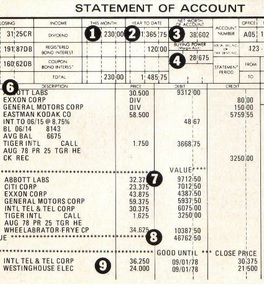
I read a quote by Porter Stansberry this week, “Young people I meet today have a very unfortunate characteristic: they tie their feelings about their self-worth to their spending instead of to their net worth (their saving). They’ve confused trying to live rich instead of moving toward being rich. The most significant variable in getting rich is how much of your income that you save.”

I believe this helps explain why it is so difficult to get someone young to save and invest: all they observe about their peers and heroes is their spending. I never see brokerage statements posted on social media. Expensive trips, yes, rental-property portfolio, no. Spending is visible, tangible, and pleasurable, while saving is boring, invisible, and a deprivation.

I prefer to spend money on income-producing assets. Assets such as: securities with dividends or interest, property paying me rent, or other assets with a business that produces income. While other people are shopping in malls, I’m examining cherry-tree orchards for sale. While others are buying big electronics on payment plans, I’m receiving payment plans from secured real estate notes. While others are looking to buy a recreational RV, I’m evaluating an investment that leases RV’s to dealerships. One side is spending money and becoming poorer while the other side is investing money to become richer. The consumer side is killing their money while the investor side is putting their money to work so they personally don’t have to actively work as hard.

Which camp are you closer to: the spending addict or the asset addict? I’m not saying that any or all spending is poor choice, it is just that in my experience, along with Porter, that spending is far overvalued while saving and investing are underperformed by the vast majority of people.

Menu Title