Personal Finance Archives - Page 13 of 20 - Financial Literacy

Archive for Personal Finance

Medical tourism still increasing

passenger jet

Americans traveling abroad for cheaper medical treatment is still increasing. After the financial crash of 2008, Americans out of work or earning less increasingly turned to offshore facilities for cheaper medical procedures. There are world-class medical facilities in India, Singapore, Costa Rica, Philippines, and Mexico where Americans spend only 10-20% of what it would cost in the U.S.

The term “medical tourism” arose because people were saving so much by going abroad that there was plenty of money left over for touring around either before or after their medical treatment. As an example, dental procedures in Mexico (with American trained dentists) are roughly 20% of the cost in the U.S. One man in Alaska was quoted a price of $65,000 for extensive dental work that he needed. He then found a U.S. dental school where students would do the work for $35,000; but then he actually had the work done in Mexico where his cost was only $3,000.

There are many procedures that are cost prohibitive for people without insurance or their insurance has high deductibles, or their insurance doesn’t have specialists in the area. Medical tourists have been able to save $150,000 for cardiac surgery; $80,000 for double knee-replacements; or $700 for a tooth cap.

Prestigious medical institutions have expanded abroad to expand their brand. For example, Harvard Medical School and Mayo Clinic have posts in Dubai, India, and are looking to expand in other countries as well. These efforts help raise the level of world-class healthcare for locals and medical tourists.

If you are interested in offshore medical treatment, the best place to start is a medical tourism agency because they are experts and it is free (they are compensated by the hospitals). Below are the questions you’ll want answered up front:

  • Different countries have different areas of expertise, what is your procedure and who is the best for that?
  • Has the facility received an ISO quality certification?
  • Aftercare and emergency treatment – if something goes wrong, where do you get emergency care?
  • Background checks on doctors and patient recommendations?
  • Several price quotes from different facilities?

While many Canadians come to the U.S. to get access to procedures, Americans are increasingly going abroad to spend a fraction of the cost for their own procedures.


Are you as smart as a squirrel with your money?

squirrel

In its simplest terms, managing money is simply this:

Produce more than you consume, and then save the difference.

In order to survive over the winter, insects like bees perform this by storing extra honey and animals like squirrels store extra nuts.

Humans must also do likewise:

  • Extra savings for emergencies and maintenance
  • Extra savings for large purchases like vehicles, education, and vacations
  • Extra savings for retirement

But you cannot save until you actively produce something for the marketplace. In order to consume more you must provide more; by acquiring more skills and experience that is worth more to other people. The money that you are able to save can also be invested so that it is producing money for you as well in the form of dividends and interest income. A result of consistently saving money in excess of your expenses is that: each time you get paid, you permanently increase your net worth. Continuing in this manner, month after month, is how you build financial stability, stay out of debt trouble, and build a bankroll that is earning an increasing amount of money for you as well.

So many people do not have basic squirrel money-management down. Instead, they

  • Spend all their income, so they have no savings
  • Spend beyond their income, building up debt
  • Instead of increasing their income, they focus on distractions like tax tactics or coupons to save tiny amounts of money

Start with a solid foundation in squirrel money management first, and only then move on to more advanced financial concepts.

Beware of creeping fixed-costs

subscriptions

The illustration of a goat tied to a tree so it can be milked is an accurate depiction of what both governments and companies are continually attempting to do to your wallet. These entities would like to turn you into an ongoing annuity; making regular payments to them forevermore. Businesses call it “a subscription business model.” It is your financial role to minimize these from consuming your income. These ongoing costs raise your monthly fixed expenses, leaving you less money for saving, investing, and normal spending.

A necessary fixed expense may be rent, electricity, or car insurance. But beyond these basics, you can go crazy by adding a never-ending list of additional fixed expenses. Each additional fixed expense can slowly creep up and subsume far too much of your income.

Let’s go through some common fixed expenses that many people have:

  • Cable TV with extra movie channels, sports packages, and on-demand movies
  • Cellphone service with extra data plans, insurance, and features
  • Yard fertilizer service and pest control plans
  • Life insurance that is no longer needed
  • Identity theft protection and credit monitoring plan
  • Time share vacation package
  • Monthly charges for bank accounts, financial software/apps/advisors
  • Alarm system service
  • Website hosting with endless feature upgrades
  • Appliance maintenance plans
  • Hobby clubs with monthly membership billing
  • Computer backup plans, malware & virus plans
  • Health club membership
  • Streaming music and video subscriptions
  • A themed box-of-the-month subscription: coffee, wine, candles, beef jerky, etc.
  • Storage unit for items worth less that what you’ve paid in storage rent

The point is: a relatively small fee of $9.95 per month may appear affordable for a service, and it may be necessary for your circumstances, but when you have many of them, they accumulate to a lot of money being vacuumed from your checking account. I was helping a friend struggling with his debts and found that he had 3 monthly recurring charges on his credit card for services that he had never used! Meanwhile, the financially-aggressive people that I know actively drive down extraneous fixed expenses. They do this so they have money available to invest or splurge on items and experiences that are most important to them.

All flash and no cash

50 cent cd

Keeping up with the illusory Joneses

Famous rap star 50 Cent just filed for personal bankruptcy. Right up until the court proceeding, 50 Cent was sending his 8 million Twitter followers images of his flashy lifestyle. His selfies frequently included exotic cars, piles of cash everywhere, and expensive jewelry. In court, he admitted that his lifestyle was a fraud: the cars, jewelry, and luxury items were borrowed. He filed for Chapter 11 bankruptcy to restructure the $50 million that he cannot repay. What prompted the bankruptcy was a new judgment he lost a couple days ago for $5 million; for a privacy violation by posting a sex-tape online without permission from the woman. This judgement was in addition to another $17 million case that he lost to a headphone company.

Just a couple years ago, 50 Cent was reported to be worth well over $100 million from a water deal. But if your spending far outstrips your income and assets, no matter how much money you start with, you’ll be headed to bankruptcy court as well.

50 Cent may not have much financial literacy (he admits that he has no idea what the value of his branding deals may be), but his paid and licensed accountant should be well versed with his finances. Apparently, this was not the case. 50 Cent’s accountant had never met him, left material assets and liabilities off of his balance sheet, and did not know key elements of his lifestyle spending. Another important financial lesson is: if you do not have expertise to perform a task, you must still know enough to manage these financial experts working on your behalf.

Yes, it is possible that this bankruptcy is just a ploy to get out of $22 million in judgments, however, it seems unlikely because he’d be committing perjury and damaging his reputation for what would be a small amount to his reported $155 million net worth just a year or two ago.

The financial literacy lesson that too many sports stars and celebrities learn too late, is that your spending must always be at a sustainable level to your income, no matter how high or variable that income may be.

How to get free* stock options

broker floor

To be granted valuable company stock options, you normally had to be an underpaid employee at a start-up company for many years. And even then, the odds were only 1 in 10,000 that your company would be bought or become publicly traded so that the shares would be worth anything.

Now there is a company that allows you to perform a checklist of tasks to assist a start-up company in being used and promoted, and that qualifies you for a block of stock options. There is no limit to the number of companies you can do this for and you can choose only the ones that you want to support. Your stock options are a reward for being an unpaid marketing consultant and/or user of the product.

Like any lottery, most of the stock options granted will never be worth anything, but some will become valuable, and a few will possibly become a life-changing amount of money for you.

The company brokering these stock options is called RocketClub.co and is, itself, a recent start-up using this method to grow the company. Since they just began, they only have a few companies to choose among, but there are many new ones in the process of signing up.

Should you accept a pension buyout offer?

retired

More companies are seeking to end their pension liabilities by extinguishing them with a buyout payment to those who were going to receive pension payments. Pension costs are rising which is spurring companies to get out of pensions. Two main costs are increasing: mandatory federal insurance on pensions and mandatory return assumptions are falling. When you receive a buyout offer from an employer, how do you decide what to do?

I recommend going through these five considerations for any buyout, each of which will tip toward or against accepting their offer.

  1. Are they offering you a good deal?

For example, if they are offering you $40,000 for your $350 monthly pension, you must evaluate if their offer is an appropriately high enough to replace it with an annuity. You do this by contacting a few insurance agents and ask how much it would cost you to purchase an annuity of $X, starting in X years (when the pension payments would begin). You will receive price quotes from the insurance companies but these are most likely to be higher than your employer’s offer. But how much lower is your employer’s offer, is the discount 5% or less (Ok, not too bad) or is the discount greater than 10-15% (a financially bad deal). You could also ask the agents to arrive at a comparison by going the other way, starting with your employer’s offer and then determining what their annuity payment would be.

  1. Is money in my hands a bad location for money?

Once you receive your payout, are you more likely to spend it all now or prudently buy an annuity that replaces it? If you might be tempted to spend it or invest it poorly, I recommend that you reject the buyout and keep the money out of your hands.

  1. How financially stable is my employer?

Has your company been around for 125 years or just 3 years? If your employer is not financially stable and may likely run into financial trouble in the future, your pension plan may be taken over by the federal pension system. If this occurs, you will likely face a reduction in benefits, sometimes it is a very severe reduction in your pension payments. If your employer is not long lasting or stable up to this point, I’d be far more likely to take any buyout offer to maximize the pension benefit before it shrinks. (A relative had his pension taken over by the federal government – they cut the payments in half and delayed the retirement date that he could start receiving it by an extra 5 years).

  1. Does your pension offer extra benefits?

For example, your employer’s pension may allow for early retirement or spousal benefits that make your employer’s pension far more valuable than a regular annuity. This makes a comparison more difficult but the more benefits your pension offers, the better it is to keep it.

  1. Taxes and penalties

When you receive a lump sum, you must immediately place it into an IRS qualified retirement account, such as a Roth IRA. If you do not, you’ll face a 10% penalty and ordinary federal and state income taxes on the entire amount. Are you prepared to move this money to an appropriate location before you receive it or will the payout be vaporized by taxes and penalties?

In general, it is my opinion that your money in someone else’s hands is always a highly risky location and should be avoided. So I would be inclined to accept the buyout payment unless some of these five considerations excessively tilted more toward leaving the pension money with my employer.

Art exhibit highlights financial mis-steps


credit cards 2

A new art exhibit by photographer Brittany Powell is called, The Debt Project. It is a series of portraits along with the models’ stories of how they created their debt situation. Powell said she wanted to create a conversation about debt and stop the isolation people feel about it.

Any amount of debt can cause stress and some stories are disheartening to read – such as debts from medical bills and long-term unemployment. However, it is clear that most of the debts were created by various forms of financial illiteracy:

  • Basic financial illiteracy – leading to large consumer debt and back taxes
  • Student loan illiteracy – leading to an insurmountable amount of debt
  • Business illiteracy – leading to a failed business with significant debt
  • Homeownership illiteracy – leading to an unnecessary foreclosure and debt
  • Car ownership illiteracy – leading to repossession and net worth destruction

If these people had been given an education on financial literacy, they could have been saved from heartache and difficulty. Several of the models recognized that they didn’t know anything about money and a few blamed society. But they all would have been financially better off than they are today with financial literacy.

Luxury cars at bargain prices coming soon

mercedes

Today, there is a perfect storm of demand for luxury cars:

  • Interest rates are cheap
  • Gasoline prices are low
  • Luxury car manufacturers are offering lower-priced models

According to Edmunds.com, as a result of those factors, entry level luxury cars are 60% leased, up from only 43% being leased a few years ago. The arithmetic is that you can purchase a used average-price car for the same payment as a new entry-level luxury car, so more people are opting to lease the luxury car. Brands such as BMW, Audi, Mercedes, Lincoln, Lexus, and Acura.

The financial opportunity will arrive in a year or so when all of these extra leased luxury cars begin to exit their lease. Later in 2016 through 2018, there will likely be a glut of these used luxury cars that will be less than 3 years old with low miles. People that are financially savvy, seeing this coming, may be preparing to grab a deal. When the prices on these cars fall with the increased supply of off-leased vehicles, you will likely be able to buy one that you like at a dramatic discount from the original sale price.

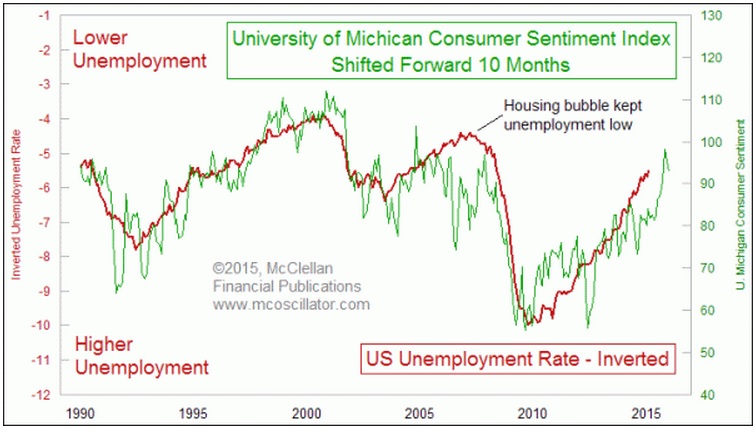
Consumer sentiment points to improving unemployment

consumer sentiment

Over the last 60 years, there has been a strong correlation between consumer sentiment and the unemployment rate. As can be seen in the chart, by a lag of 10 months, when consumer sentiment improves then the unemployment rate improves; and visa-versa.

The current consumer sentiment has run from 81.3 to 98.1, and if the correlation to the unemployment remains, then the U.S. can expect another 10 months of the unemployment rate improving.

What are some possible implications of a dropping unemployment rate?

  1. It means that for the next 10-12 months, the stock market may continue to be steady-to-upward as the unemployment rate improves.
  1. It also means the U.S. Federal Reserve will be more inclined to begin raising interest rates with such a low unemployment rate. So if you have any loans, now would be the time to re-finance them to lock in a low rate before interest rates rise.
  1. If you are considering making a career move, the next 10-12 months may be a favorable window in which to make that move.

Obamacare rates to skyrocket in 2016

operation

Whatever you are paying for health insurance from government exchanges this year, it will likely be higher next year. Prepare your budget for several out-of-pocket increases for 2016.

The health insurance rates on exchanges are set by the government. The rates for 2016 are being analyzed now and major insurers are requesting premium increases from 8% to 52% across the country. Insurers are experiencing actual costs far higher than expected and want these increases to begin to close their financial gap over the next few years.

(Unfortunately for taxpayers, any losses by the health insurance companies on exchanges is funded by taxpayers. For example, the largest insurer in Oregon experienced costs that were 61.5% higher than premiums that they charged, so federal or state taxpayers will be funding that loss).

There are a few other regulation price increases for 2016:

  1. The maximum deductible amount for an individual increases from $6,600 to $6,850
  2. The tax penalty for employers who do not offer health insurance increases to $2,160 per employee.
  3. The tax penalty for families who do not have health insurance increases to $2,085.
  4. A second tax penalty for employers: those that do offer health insurance that the government deems as unaffordable will increases to $3,240 per employee.

Obamacare subsidies are also being disputed in courts so there is not a definite financial number for residents of every state that expects to receive a subsidy for health care premiums.

The sooner you start budgeting for future expenses, the more stable your financial situation will become. Under the Affordable Care Act, mapping out your health costs and insurance is becoming a larger and more complex part of everyone’s expenses.


Menu Title